Category: Tag:

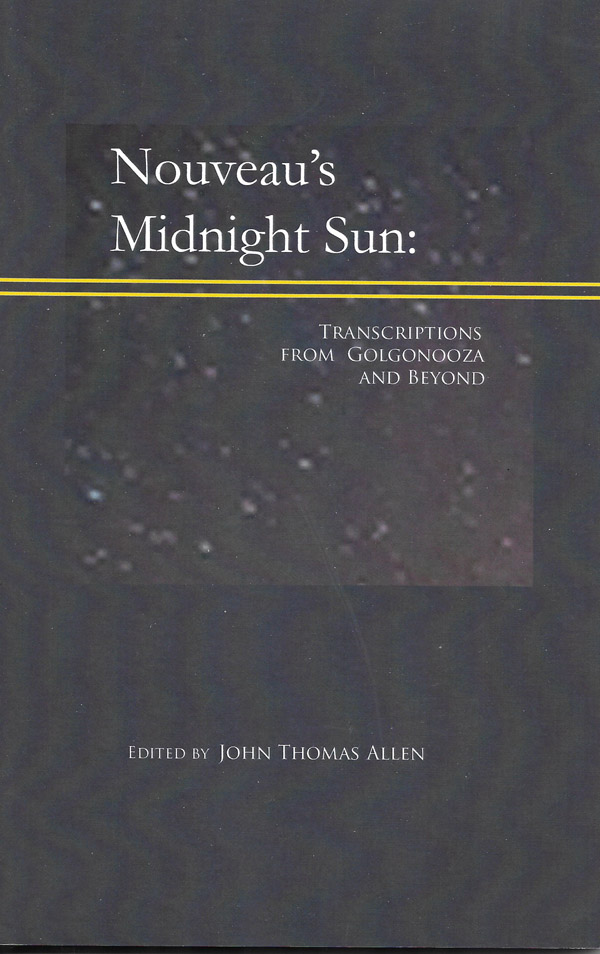
Nouveau’s Midnight Sun: Transcriptions from Golgonooza and Beyond

Edited by John Thomas Allen, this collection of modern Surrealist poetry carries, as Andrew Joron has said, the revolutionizing force of Surrealism into the twenty-first century, offering a stellar gathering of writers that includes Julian Semilian, Lee Ballentine, Adam Cornford, Mark Statman, David Lehman, Joseph Lease, Peter Cherches, Allen Parmenter, John Olson, Christina Zawadiwsky, J. Karl Bogartte, David Shapiro, Donna Snyder, Bruce Boston, Brian Lucas, Marilyn Kallet, John Yau, Sutton Breiding, Kathryn Rantala, and the editor.  An extensive historical and philosophical introduction by the editor provides insight into the birth of this anthology as well as relevant biographies for the contributors.  Onward Surrealists! (Christopher Merrill)

See the long but interesting review from The Fiend Journal, Blackpool, England:


Reviews

Nouveau's Midnight Sun carries the revolutionizing force of surrealism into the twenty-first century. This much-needed anthology shows that surrealism, in renewing itself, has not mutated beyond recognition, but only has brought forth the farther, deeper implications of the original Manifestoes. As eccentric to established culture as Breton would have wished, these poems, in rewriting & rerouting surrealism, still know to bring the outside in.

Andrew Joron

Born out of “deranged fever,” as the author John Thomas Allen puts it, the Noveau’s Midnight Sun: Transcriptions from Golgonooza and Beyond emanates from his insatiable quest for the angels and demons (theories and principles) of surrealism, as a phantom that haunts him even when he was bedridden and convalescing from a harrowing Lyme disease. Allen has methodically gathered leading post-postmodern surrealist poets and artists to reecho the vision of the Surrealist movement founder André Breton. Albeit stylish and highly refined from its avant-garde predecessor, the surrealist poets and artists explore motley themes that define what surrealism is in the 21st century, from a movement of chance, dream, and anarchy to an aesthetic of oddity, deviancy, science fiction, magic realism, ambivalence, absurdity, and decay. The author’s introductory essay alone is, in itself, an inimitable literary piece akin to Nietzsche’s Thus Spoke Zarathustra

Danny Castillones Sillada

The innovative writings in this anthology stretch language into brilliant new hallucinatory shapes. Like absinthe mixed with Red Bull, they will ruin your waking hours the way you didn't know you wanted them ruined.

Meg Pokrass

Thanks to all of you for this collection, which is not only adventurous and delightful but also instructive. Bravo! The poems veer in every direction, and yet the reader knows that there is a mysterious destination, which will be marvelous.

Christopher Merrill

Two new reviews for Nouveau’s Midnight Sun have surfaced on Amazon, pointing us toward the heart of ths stimulating collection.  Andrew Mendez: “It is here, in this collection of hands, that surrealism’s spirituality can be found…John Thomas Allen [and] eleven other hands…gathered under the dark sun of printing words on paper…and offering them as Eucharist laced with the marvelous.”

“…we are all connected by the nature of our content,” adds Stephen Kirin, “and these transcriptions shed light on us… dazzle the senses with another humanity.”

I appreciated the way the book cut cross-sections into various strains of surrealism, suggesting further threads to pursue (Lee Ballantine's magnetic journal Ur-Vox as well as the ongoing work of Black Widow press come to mind). It's heartening to see so much variation within the approaches. I found myself particularly drawn to the prose works. Highly recommended!

E. Baus

John Thomas Allen wants to know if Surrealism is dead. Nouveau’s Midnight Sun answers that question with a resound no. Surrealism may be scorned on the surface as period in artistic experimentation, but this book declares that its effects have seeped into the contemporary consciousness with more purpose and determination than we are capable of admitting. Allen asks if the surreal in poetry exists on a fringe, still dwelling in that submerged space of the subconscious from whence it sprang, and the answer, in our modern world of celebrated fragmentation, of open windows upon open windows of stimuli, is that the surreal is how we now process the world. The poems in these pages do not frighten us the way the images of Dali shocked and alarmed the staid minds of the past; rather what we are seeing now is the new truth, that the fragmented and shocking is how we are able to process the world.

Nouveau’s Midnight Sun is a handbook to Surrealist poetry. It is an explanation by example. This assemblage of poems, from a spectrum of poets, explores the distinction between what Celia Rabinovich calls the sacred and profane. In surrealist poetry this distinction surfaces in the space between the absolutely experimental poetry that wants to disassemble all notions of meaning, and the idea that what is most effective in asking readers to experience a new kind of poetry is to introduce them to something familiar and then destabilize it. We must remember that in the paintings of Dali, the world is at first familiar before it becomes stretched to new meaning, beyond time and space.

Between what is real and what is surfaced from the subconscious, between what is recognizable and what is distorted, it is difficult to tell which is the sacred and which is the profane. For the surrealist, the regular, or regularity of the world, is often the profane.

Surrealism is still the scream in the confusion, though the confusion has grown. We will always need surrealism, because we are all as Allen says in the poem “Genome Dice”, Cryptographers, digging through books in the library’s bowels, and we scream with joy to have found the means to express ourselves beyond the confusion of words.

If as Borges says that words are dead metaphors, like coins in which the markings have been rubbed off, then it is the poets work to re-render the value of that coin. The coin, as it were, of division between the familiar and the new in poetry is the word. The poems in Nouveau’s Midnight Sun restamp the distinction between the known and the unknown, defamiliarizing meaning with surprise and style. On one hand the job of all poets is to remind us what we already know, but for the surrealist poet, the job is to remind even poets that the revised meanings the words a poem can offer are larger, more dangerous, and scarier than we can imagine.

We are guided through the liminal space that surrealism explores by a variety of American poets. In “This is How Sentences are Born” John Olson says this is how we navigate our way through all the debris life throws at us… Zombies disembarking from the tour bus.

The language is dead but coming for us, gnashingly.

In the poem “I set Flake…” a poem about the terror of answering machines and the impossibility of receiving a clear message, poet Peter Cherches asks “Why does sarcasm belie onerous exactitude?” An acknowledgement that merger of reality and the world is suspect and, if unable to be overcome, must be ignored for sanity’s sake.

One of the great allures of surrealism is that it does not feel its own responsibility. It is playful and disrespectful, willfully violating sense and meaning. It can’t be defeated because its operating theory is that theories are as baseless and fool hardy as nonsense. Each artist is free to make their own rules and everything is permitted. In his poem “Ambivalence” David Lehman declares:

of fears the fear of failures is the least

to which we cling beyond the schism

to which we cannot compare the pornography of Fascism

or live without angst in the castle like a beast.


This volume reminds us that play is at the heart of the Surrealist revolution. It is a call to bring us back to the revolution of art, and that art can matter in making change.

Jay Snodgrass